The Truth in Truth and Reconciliation Educational Board Game
By James Darin Corbiere (Waabi Makoohns), comic book writer, illustrator, and board game creator, Langford
My name is James Darin Corbiere. I am Aanishinaabe, Bear Clan from Wii kwem koong on Manitoulin Island, Ontario. I am a former police officer and Indigenous language teacher living in Langford on Vancouver Island. I am a comic book writer and illustrator, artist, and the creator of The Truth in Truth and Reconciliation Educational Board Games.

I spent most of my 11-year teaching career in Sault Ste. Marie, Ontario, where I taught Ojibwe language courses, geography, and Canadian history. When the Ontario Secondary School Teachers’ Federation (OSSTF) put a call out in 2016 for Indigenous teachers to help create resources that could be distributed to OSSTF members to support teaching about Indigenous issues, I applied and was accepted.
At first, I created a puzzle intended to show how treaties and purchases over time resulted in the creation of Canada. Each puzzle piece had essential information about various treaties that participants would attach to a precolonial map of Canada. The progress of the transition from Indigenous land to Canada could be seen in this activity.
Over the May long weekend in 2017, I began preparing an exam review for kids in my Grade 10 Canadian Contemporary History class. At first, I wrote up “cheat sheets” of essential historical information. Realizing the study aid would likely end up in the recycle bin or at the bottom of back packs, I upgraded from sheets of paper to flashcards with the same historical information. Even then, the students would get bored, so I leveled up by making a game out of the learning.

The kids loved the game and did well in exams. They encouraged doing more with the game. That preliminary board game, made from dollar store recipe cards and foam core board, went on to become The Truth in Truth and Reconciliation Educational Board Game.
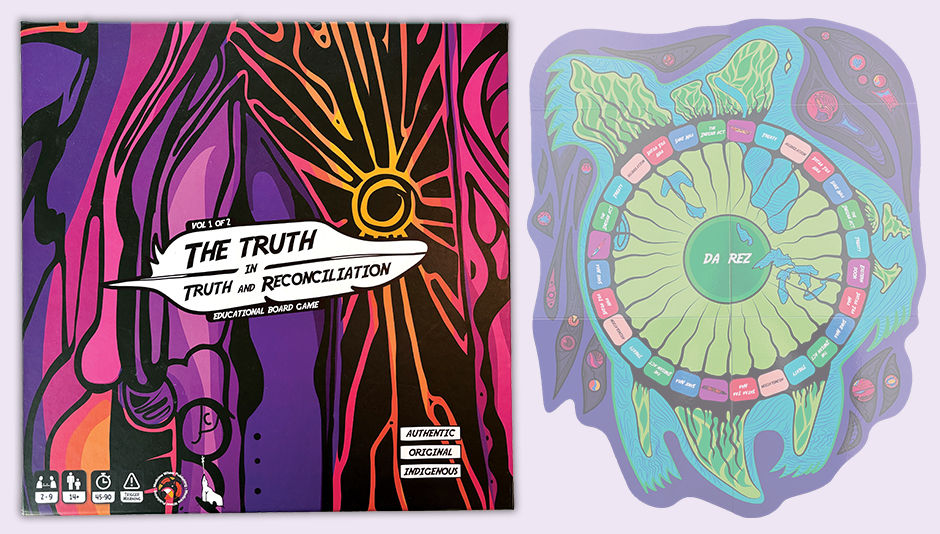
The goal of the game is to collect four Eagle Feather cards and survive. The players in the game are each assigned a Role card representing Indigenous groups in Canada. The Role cards also assign sex and status (for example, non-status First Nations). The categories used to create Role cards are true to divisions used in the Indian Act.
The Truth and Consequence cards describe Indigenous experiences of Canadian history and are based on the real-life impacts on Indigenous Peoples. Value cards are surrendered to the Church and Crown throughout the game based on the information shared on Truth and Consequence cards. Value cards include land, language, culture, and identity. Historically, Indigenous Peoples did not have “money” that was stolen through colonization, but we did have land, language, culture, and identity. When a participant loses all their Value cards, they become Assimilated.

The Church and Crown are not playable characters in the game, but they do receive Shame cards for their dishonourable actions. When I first developed the game, my publisher insisted I remove the Shame cards. I declined and was dropped by the publisher in 2018. That same year, I moved to BC and connected with my local union office in Prince George, who then connected me with the Aboriginal Education office of the BCTF who supported my efforts. We have been working together since then.

I later approached Medicine Wheel Publishing in Victoria who picked up the game and published 3,000 copies. The Truth in Truth and Reconciliation Educational Board Game was released in August of 2024, and it is nearly sold out as of January 2026. The game comes with all components needed to play, plus a guide book. The guide book includes reflection questions to help students think more deeply about Canada’s history.
All of the research, writing, and artwork on the cards, board game, and guide book is my own. The box art comes from a piece of mine called Ba-ka-de. Ba-ka-de is black on a purple background, and the purple represents healing. If you get hurt, if you bump your arm, or something happens and you get a bruise, that’s the colour of healing.
In addition to the original truth game, we have also published the elementary and middle school version of The Truth in Truth and Reconciliation game, which was released in September of 2025 and is available now through various education resource retailers.
I am very grateful to the BCTF, particularly the Aboriginal Education office who have been strong supporters of both versions of the game.
The grand vision, right from the early days in May 2017, is to create a suite of resources for reconciliation, beginning with the truth games, referred to as Volume One, to be followed up by the reconciliation games, or Volume Two. The original truth games contain general information, while expansion decks of Truth and Consequence cards are planned for each province, i.e., one deck for BC, one for Alberta, Quebec, etc., all across Canada. In addition to these efforts, we are working on creating a French language edition.
From the prototype in May 2017 to the published copies in August 2024, it has been a seven-year long journey to see this vision through. From the OSSTF, to the students who first played the prototype game, to the many leads and connections made along the way, I am grateful to everyone who has helped me achieve this goal.
Miigwetch Miigwetch Miigwetch.James Darin Corbiere – Waabi Makoohns