Overtime: Burnout in athletic directors

By Graham Notar-Maclean, athletic director and English teacher, Delta
Burnout is a hot-button topic these days. Unfortunately, for us as educators, it is ever-present too, and misunderstandings and misrepresentations about it do more harm than good. Clinically, burnout can be characterized as a stress disorder resulting from a combination of physical and psychological pressures experienced over time. It has three major categories: emotional exhaustion (the typical “burnt-out” experience of being overwhelmed), depersonalization/cynicism (feeling like your work doesn’t matter; feeling disconnected), and reduced personal accomplishment (like you and your work are ineffective, useless, or pointless).
Professionals in human service jobs, e.g., paramedics, doctors, nurses, social workers, and, of course, teachers, are much more likely to experience burnout than people in other professional work because of the nature of our daily stressors. The list of contributing stressors for educators is enormous: multifaceted student needs, ever-increasing class sizes, non-educators making decisions for us, a sense of powerlessness against the forces of political division, cellphone culture, rampant apathy, and dismissal of behavioural expectations.
In the process of researching educator burnout for my master’s thesis, I stumbled upon another subset of teachers who rarely ever get mentioned in these discussions: athletic directors (ADs). Ads are responsible for organizing every single extracurricular athletic program in schools. That includes finding coaches internally or externally for every team; making sure every adult who engages with students has appropriate criminal record checks; ordering, managing, storing, distributing and collecting jerseys; organizing financing for each student who participates in sports at a high school level; student registration; scheduling every try-out, practice, tournament, and game; communicating with parents, coaches, league co-ordinators, tournament hosts, facilities managers, bookings agents; and planning and co-ordinating end-of-year athletic banquets. This is another incredibly long and by no means exhaustive list.
I surveyed ADs in I about their experience of workload, time put in outside of contract hours, supports or lack thereof, and general burnout measures. What follows are the survey results and anonymous quotes from some of the respondents.

Over half of the ADs who responded do this job alone, 50.4% on the chart above, and few schools have supportive networks for athletics. When asked how they go about getting staff members involved, the number one method for getting teachers to support with athletics was a combination of “begging, bribery, guilting, offering athletics merchandise, pleading.” One respondent claimed, “People just don’t want to help anymore.” Another wrote, “I don’t know that I could do the AD role alone the whole year without burning out.”

… during volleyball season I am in the building from 6:00 a.m.–9:00 p.m., 3–4 days of the week (not including tournaments) … I think that no one really gets how much it affects my personal life, and that is assuming that everything is running smoothly and there are no major issues. – Anonymous respondent
To me, the results above and below are the proverbial canary in the coal mine. Over two-thirds of ADs stay late beyond instructional hours four or more days a week. Almost 43% of them do so every single day in order to complete their required responsibilities. This should raise eyebrows about the workload of these roles. As one respondent shared, “I come in most Sundays for 4–5 hours to get ahead as much as possible for the following week. I currently put in 60–70 hours every week (I coach as well). [A] 60-hour week is a short week that rarely happens.”
I put in just under 16 hours of work yesterday. I wish I could say that was a one-off, but I would be lying. – Anonymous respondent
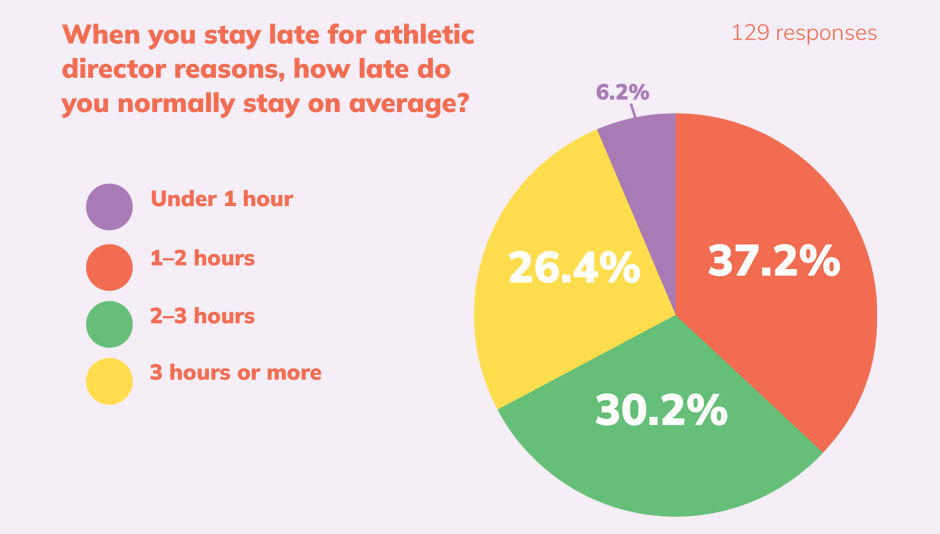
Coupled with the previous question, the above result stunned me most. Over 56% of AD respondents stay, on average, two or more hours beyond their contract hours, with over 26% of them staying three hours or more.

What’s striking in the chart above is that the overwhelming majority—93.8%—of AD respondents feel this role adds a medium or higher level of additional daily stress. Here’s what some respondents had to say:
The value of sport in schools is inexplainable, yet we are overworked and don’t see an end in sight unless we leave the AD “job.”
It feels like every AD I talk to is reaching a breaking point, and that our current school sports system is at risk of collapsing under its own weight if the people who are actually responsible for making it happen are not compensated fairly and supported from all levels. So many ADs make the personal and professional sacrifices to make the job happen just because “that’s the way things work” or “it’s the way things have always been done” and that is a totally unsustainable model that can’t lead to a thriving school sports environment in the city or in BC. I wish people knew about just how much time, effort, and sacrifice is necessary to maintain the current system, and how quickly it would all fall apart if we collectively just couldn’t do it anymore.
One of the struggles is that both teaching and AD [work] are very valuable, but it is extremely difficult to do both well, so it becomes defeating.
While the survey didn’t specifically ask about the impact this work has on personal lives, several respondents shared how significant the effects can be:
All this workload affects our personal lives, whether it be relationships with significant others, or people’s own children. My friends often joke that I am MIA for a good chunk of the year because of all of the coaching that I do.
… many ADs make the personal and professional sacrifices to make the job happen just because “that’s the way things work” or “it’s the way things have always been done” and that is a totally unsustainable model …
The survey also didn’t address concomitant illnesses like anxiety, depression, high-risk coping, sleep disorders, or other stress-related mood pathologies. It didn’t specifically ask about the impact this has on classroom teaching roles and on students, how hard it is to do both AD work and classroom work well, or higher than average turnover rates. Nor have we talked about elementary physical and health education (PHE) teachers doing basically all this work without supports of any kind.
I’m tremendously lucky that I have an amazing PHE leadership teacher at my school, supportive administration, and a strong, stable cohort of teachers and community coaches that make my workload more sustainable. Many ADs do not.
So what can you do? Talk to your site AD and ask them what supports they need. The fate of high school athletics may depend on getting more teachers, like you reading this, into the game. You can connect with your local AD and union to advocate and address the unsustainability of this role. Raising awareness about the stressors we all experience makes the suffering we endure for our work lighter, and discussions like this one can help.


