The power of the English First Peoples course: How Indigenous philosophies support healing
Updated: Feb 27
By Sophie Boyer (she/her), teacher-librarian, West Vancouver
I was in year three of teaching the EFP course when I was recovering from radiation, unsure whether I could take on another school year. Add on the untimely loss of a best friend to the same cancer I’d been fighting, and there were bound to be some challenges with mental health, energy, and spirit.
There are heart-stopping events in life that cause us to become more philosophical. A cancer diagnosis; the death of a loved one. In my mid-40s, 20 years into my teaching career, I experienced these events simultaneously.
Many pillars supported me: my family, my school community, my friends. What I didn’t expect was that teaching the English First Peoples (EFP) course would also be one of those pillars.
Indigenous education focuses on the healing strength of communities. Sharing knowledge and lessons through storytelling helps establish strong bonds that allow us to lift one another. We all know that great storytelling is transformative, but how do we quantify this? How do we pass along to others the values of authenticity and vulnerability in the classroom?
I was in year three of teaching the EFP course when I was recovering from radiation, unsure whether I could take on another school year. Add on the untimely loss of a best friend to the same cancer I’d been fighting, and there were bound to be some challenges with mental health, energy, and spirit.
With uncertainty, I prepared to meet a group of 60 new EFP students. I figured that some of them had heard about my diagnosis, so when it came to introducing myself, I alluded to the darker parts of my story. For context, in the first unit of the teacher resource guide for EFP, there is a get-to-know-you lesson where students are encouraged to bring in four artifacts to represent each of the following: family, culture, self, and peer group. (1) It creates a safe space to share what makes them unique, celebrate their heritage, and think more deeply about what relationships are important to them.
In hearing the students’ stories about their artifacts, I am reminded how grateful I am to have this position. Seeing their eyes light up as they explain an anecdote and connecting with them on similar interests is affirming. This activity is one of the best foundations for building community.
My objects in this particular year highlighted the power of friendship and memories in the face of illness and loss, focusing on the positivity of remembrance. I shared stories about my friend, who had succumbed to breast cancer less than six weeks prior. She has a legacy and I carry it with me. Ordinarily, a student bringing in a bracelet that reads “I heart boobs” as an artifact might raise eyebrows; but I knew it was meant to be a moment of connection—a bracelet bought with the intention to support breast cancer research. I had a good feeling about this new group of students.

My planning for the course included a new novel study: Keeper’n Me by Richard Wagamese. (2) I had taught the text back in 2008 with some success, and I was both curious and apprehensive about how this new generation would connect with it.
I’m glad I trusted my instincts. Together we discussed the magic of the landscape felt by Garnet when he returns home; we examined how external factors influence multifaceted identities; we noticed how characters with imperfect pasts succeeded in the present. The students explored motifs with incredible textual and visual detail. Going back to a text with several years of teaching and life experience provided a fresh and exciting perspective.
The end of the unit was approaching, but with my limited energy reserves, leading and assessing a large final project loomed dauntingly. What would be an authentic way to assess learning and understanding of Keeper’n Me? A sharing circle came to mind: celebrating individual voices while building community. I had shied away from sharing circles as a white educator, fearful of doing something incorrectly. Moreover, the old me would find it difficult to dedicate an entire class to an activity of this kind: always under the pressure of deadlines and to get through curriculum goals. I’ve learned that slowing things down is more valuable than staying on the express train of written output. Keeper’n Me revolves around the unhurried philosophy of learning promoted by the First Peoples Principles of Learning. Thus, it was the ideal time to go out of my comfort zone by taking things slowly and intentionally.
Students were given the parameters for the activity (see below) a few weeks in advance of the sharing circle. I shared resources on talking circles and we watched a video that featured Xwalacktun, local Squamish artist and Elder, on the significance of the talking stick gifted to our school. (3) Xwalacktun is incredibly knowledgeable on the power of symbolism and intention through visual artifacts. He shared that the talking stick was carved from a 1200-year-old yellow cedar from nearby Squamish, and we all felt the privilege of holding this ancient piece—our circle became part of the past and present all at once. As we took turns speaking, I encouraged the students to select a part of the talking stick to hold as indicative of their learning, adding a visceral layer to exploration of themes in the EFP course.
In her “Talking Feathers for Sharing and Restorative Justice Circles,” Dawn Iehstoseranón:nha, Wakhskare:wake (Bear Clan) of Akwesasne, outlines protocols for talking circles, with a focus on the classroom. (4) She states, “Determine what is in the middle of your circle. Some circles surround a fire, some surround sacred medicines, pipes or smudging tools. In elementary school circles, often participants are comforted by a bowl of colourful stones or water.” The day before our circle, I asked students to write an intention for the talking circle on small pieces of coloured paper. In the middle of the circle, I put the papers in a basket, elevated it, and decorated it with a string of white lights—our version of a fire.
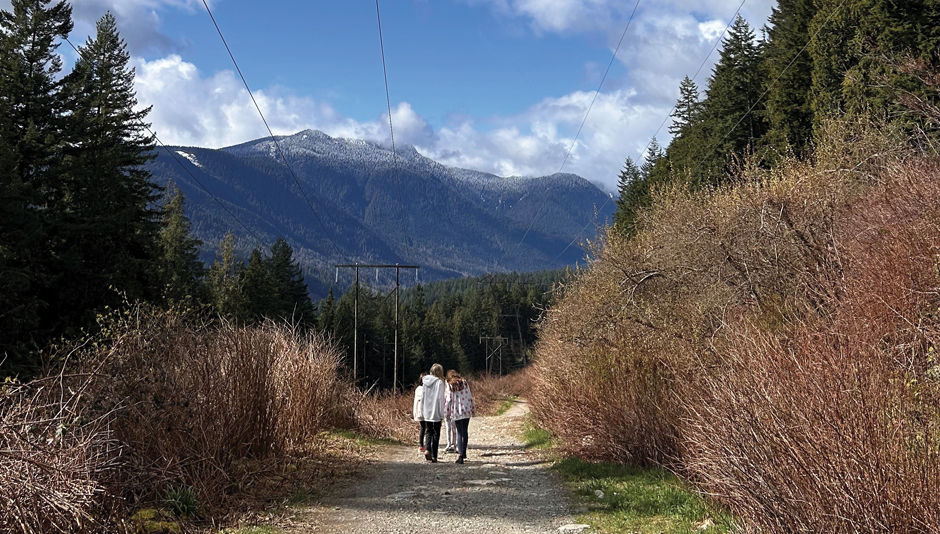
Two days before the sharing circle, I went for a walk with one of my closest friends, someone who shares the heaviness of loss with me. We were finishing up at an incline, which forced us to slow our pace. I looked up to the sky, as I often do, and noticed eagles soaring high above the evergreens. I continued on, keeping an eye on them. What started as a few eagles turned into a throng. I paused and counted: 1, 2 …15 …19. Some had majestically large wing spans, while others looked not far from hatchlings.
Eagles have special significance to the Ojibway in Keeper’n Me. They come to the main character in a dream, representing the masculine and feminine gifts of his ancestors. Garnet is also gifted two eagle feathers by his mentor, Keeper, in recognition of Garnet’s perseverance and personal growth. Eagles and their significance were at the forefront of my mind.
This eagle sighting felt serendipitous. My count landed on 19 eagles, which I equated with 19 women, including the friend who passed away. Friends from high school, from work endeavours, from neighbourly proximity, who over the years have remained in touch regardless of life’s diverse journeys. The flock of eagles reminded me of the powerful community of women in my life. As my walking partner and I rounded the corner to end our hike, a 20th, smaller eagle joined the group from the south. Without a second thought, our dear friend’s daughter came to mind, who we’ve silently pledged to take care of, or keep under our wings, in the tragedy of losing her mother.
With her, we make 20.
The power of authentic storytelling and of relying on our communities to grow and thrive: these key elements of the English First Peoples course were my survival raft these last few years.
This was the story I shared to open the talking circle. Authentically my own, and authentically connected to the learning that my students and I shared. How incredible to have a group of teenagers comment on how my story influenced them—a story made possible by the philosophies of EFP teaching.
Was it coincidence then, that a few days after the sharing circle and my eagle sighting, that I ended up in operating room 20 for the final surgery meant to prevent future cancers? No. It was a spiritual reminder that I was protected and safe, that my community was watching over me.
Before this trio of circumstances—the cancer, the grief, teaching the EFP course—I wouldn’t have described myself as spiritual. Enduring chemotherapy is akin to starting over at the cellular level, while great loss forces us to re-evaluate what is important. How fortuitous to be immersed in the principles of Indigenous philosophy to help me through these hardships.
The power of authentic storytelling and of relying on our communities to grow and thrive: these key elements of the English First Peoples course were my survival raft these last few years. As a non-Indigenous educator, I understand the fears of doing this course injustice. If you’ve felt this uncertainty, I encourage you to keep an open mind. The more you immerse yourself in Indigenous ways of knowing, the more these ideas seep into your bones and become part of your own philosophy. Push yourself to keep learning and growing by sharing the tenets and stories of Indigenous resilience. You never know how it might change your life.
Keeper’n Me final activity
Give each student two minutes to share something about what they learned in the novel study of Keeper’n Me. Do this in a sharing circle in class. The exercise is part of the self-assessment for this unit. Also ask students to write a reflection in their learning journal about the experience.
Suggestions for students to focus their statements in the sharing circle
an important lesson you learned from the novel
a short poem (written by you) inspired by the novel’s themes
knowledge you learned about Indigenous Peoples that you can use going forward
a symbol you particularly liked in the novel: what it means and why you chose it
something of your choice in relation to the novel.
Elements of sharing circles
equality
respect
trust
honesty
dialogue
sense of community
speak when it’s your turn (talking stick or other object).
1 First Nations Schools Association and First Nations Education Steering Committee, compilers, “English First Peoples Grade 10–12 Teacher Resource Guide,” 2018: www.fnesc.ca/publication
2 Richard Wagamese, Keeper’n Me, Penguin, 1994.
3 Squamish Public Arts, “Xwalacktun, Rick Harry,” 2026: squamishpublicart.com/artists/xwalacktun
4 Dawn Iehstoseranón:nha, “Talking Feathers for Sharing and Restorative Justice Circles,” Pass the Feather, 2024: passthefeather.ca/sharing-circles


